Monitoring shows you the problem. Closing the loop solves it.
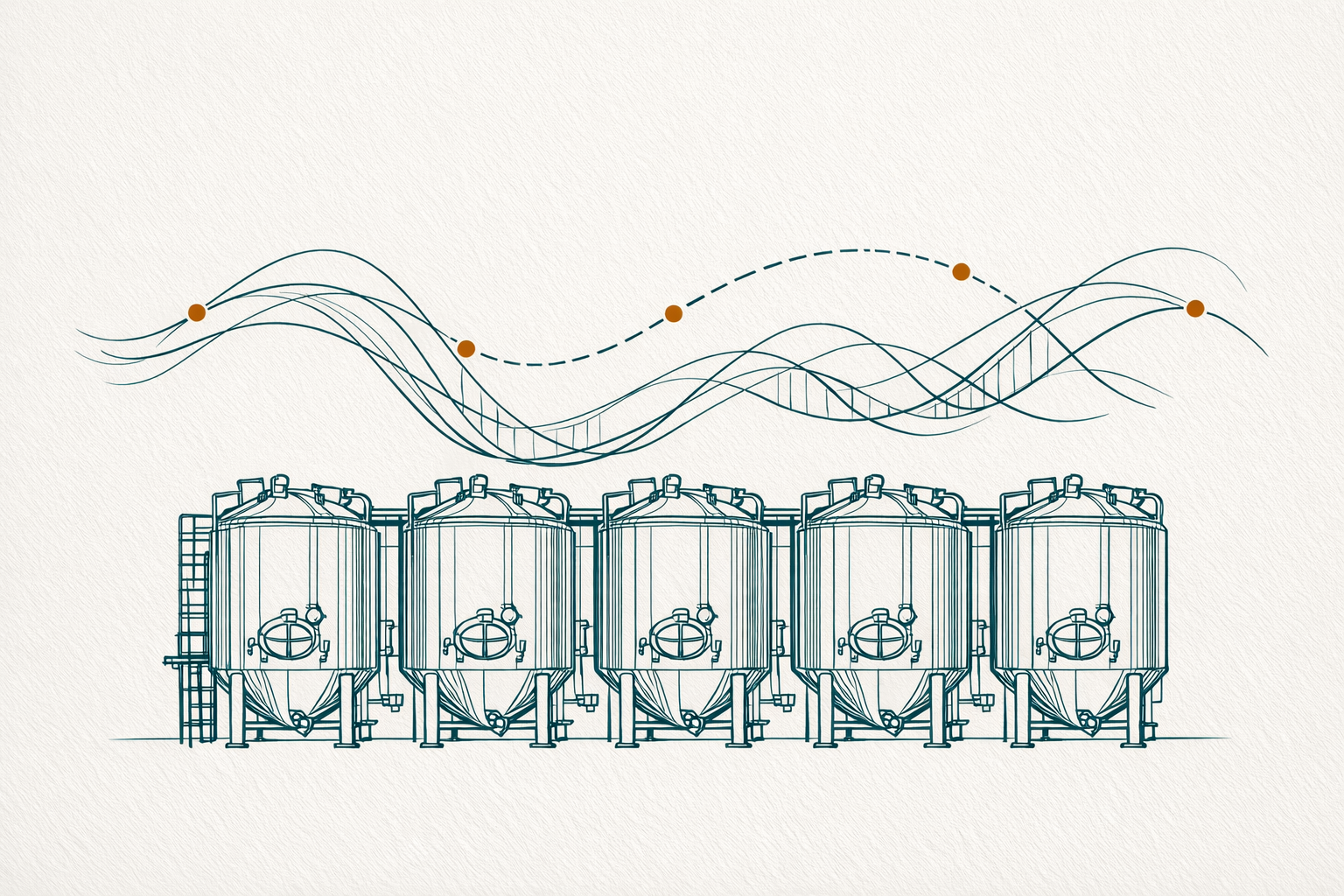
Monitoring shows you the problem. Closing the loop solves it.
Every fermentation operator knows the 2 a.m. feeling. A tank that was tracking fine all day starts to drift. Maybe the temperature creeps. Maybe a ferment goes sluggish, or sticks, or quietly turns. By the time someone notices — on the next manual sample, the next walk through the cellar — the batch may already be lost, and whatever went wrong may have spread to its neighbours.
The frustrating part is that the data was there. The tanks are wired. Temperature, pH, Brix, dissolved oxygen — most fermentation operations already capture all of it. The instrumentation isn't the gap. The gap is that the control layer holds setpoints but doesn't predict, and no human can sample every tank every hour. The plant knows what's happening now. Nobody knows what's about to happen next.
That gap is what we're building FermentDT to close.
The category: monitoring vs. closed-loop control
Most of the tools a fermentation operator can buy today are monitoring tools. They show you the dashboard. They benchmark this batch against the last one. They are genuinely useful — and they stop exactly where the value gets interesting. They tell you what happened. They don't tell you what's coming, and they don't do anything about it.
Closed-loop control is a different square. A closed-loop system doesn't just read the tank — it runs a live model of the fermentation, infers the things you can't cheaply measure, sees a batch beginning to leave its trajectory before it's a problem, and recommends the correction that brings it back. Monitoring ends at the chart. Closed-loop control acts on it.
No incumbent really sits in that square for food, beverage, and industrial fermentation. The strong AI bioprocess platforms are built for regulated pharma. The serious process-control systems are enterprise-scale and priced for it. The beverage tools stop at monitoring. We think there's a category waiting to be named — and built — for the operators in between.
What FermentDT is
FermentDT is a supervisory AI layer — a digital twin — that sits on top of the PLC/SCADA you already run, not in place of it. Four pieces work together:
- Neural-network soft sensors infer the fermentation kinetics you can't measure cheaply or continuously — sugar conversion, ethanol, biomass — from the instrumentation already on the tank.
- A hybrid digital twin keeps a live model of each vessel, fusing fermentation mechanism with machine learning so it stays accurate on real, small-data processes.
- Model-predictive control steers each batch toward a target trajectory instead of a fixed setpoint.
- Real-time anomaly detection flags stuck, sluggish, or off-trajectory ferments early — while there's still time to act.
It's an optimization layer, not another screen. It's vendor-neutral by design. And the operator stays in the loop: FermentDT recommends; it doesn't move your plant without confirmation.
Built in the open, on a real operation
We're not building this on a lab bench. FermentDT is being developed and validated through Ai26.10, a twelve-month research consortium between Atomic 47 Labs and Crush Dynamics, backed by Protein Industries Canada as part of Canada's Global Innovation Cluster network. The work happens on a real industrial fermentation in Summerland, British Columbia — the heart of the Okanagan, which has one of the densest concentrations of fermentation expertise anywhere in the country.
That matters for two reasons. First, building against a live operation keeps us honest: the failure modes are real, the constraints are real, and "works in the simulator" isn't the bar. Second, the Okanagan is where we're starting — a wine, beer, and cider ecosystem that runs on automated tank control and feels every lost batch on the bottom line — before extending across industrial fermentation more broadly.
We're also doing the science in the open. The fermentation science and algorithms behind the soft sensors and the digital twin are documented publicly — read the methods, not just the marketing.
Where this goes next
FermentDT is pre-commercial today, and deliberately so. We're recruiting a small cohort of design partners — operators across wine, beer, cider, and adjacent verticals who want to shape what the product measures and controls, and earn first access to it. The ask is "help shape it," not "buy it."
If that's you, there are three doors:
- See it run. The live demo lab hosts the digital-twin dashboard and our working prototypes — register and walk through them.
- Shape it. The Design-Partner Programme is the fastest way in. A benchmarking conversation on your own process is part of the deal.
- Stay close. The Fermentation Loop is our monthly note on building autonomous control on real fermentation — category thinking, progress, and a bit of science.
Monitoring has had its decade. The next one belongs to control. We'd like to build it with the people who run the tanks.